Stack Overflow's collapse is a warning about what AI assistants run on
Questions on the programming Q&A site fell about 99% from their peak. The cause is partly AI, partly the site's own choices, and the risk of a knowledge drought is real.
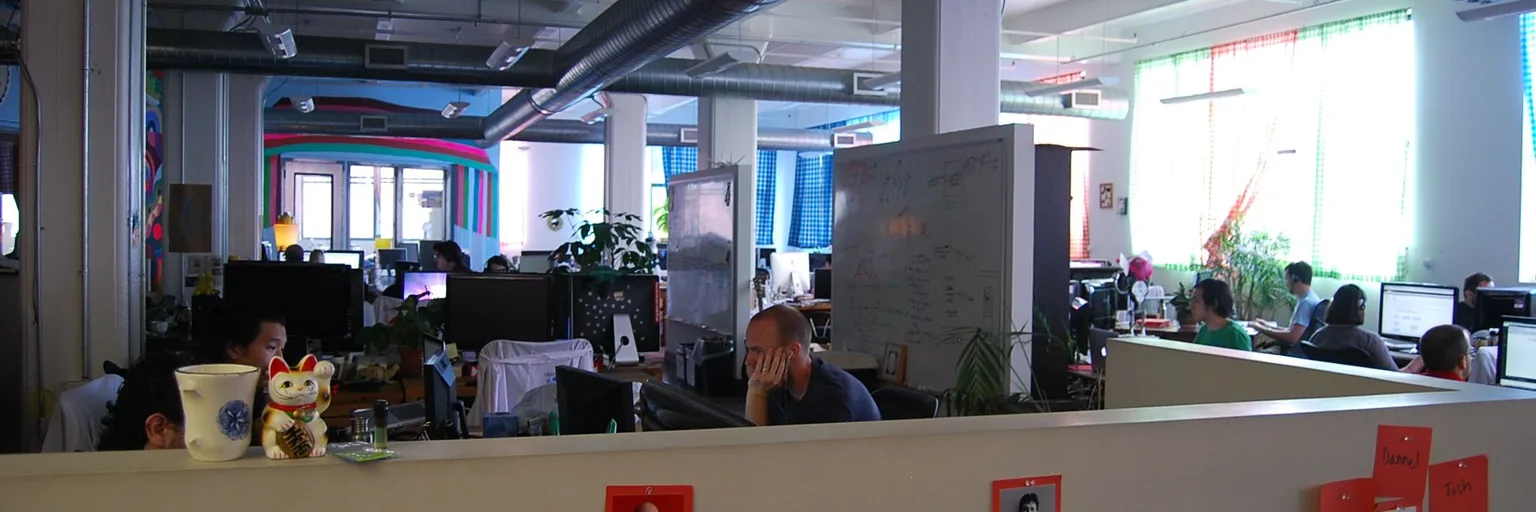
Photo: Crew crew / Wikimedia Commons (CC0)
What happens to a library when everyone stops writing books because the librarian answers faster? Stack Overflow is running that experiment in public, and the numbers are brutal.
A 99% drop, with some caveats on the exact figure
Stack Overflow recorded 1,442 new questions in July 2026, according to PPC Land, which cites the platform's own Data Explorer. The site's best month, March 2014, had 207,204. That puts July at 0.7% of the peak. Other outlets give slightly different July counts, and some undated pages claim a monthly total below 1,000 that we couldn't tie to a specific month. We wouldn't bet on one precise number. The direction isn't in doubt.
A user post on Meta Stack Overflow puts it in daily terms: 88 questions a day in February 2026 and 42 in May, against more than 6,700 a day at the 2014 high. The same post says that is fewer than in August 2008, the site's early days.
AI is the final blow, not the whole story
The tidy thesis is "AI killed Stack Overflow." The evidence says it's more complicated, and a columnist should say so. 36Kr argues that the decline began about eight years before ChatGPT. Its explanation is that around 2014 the site got stricter about review and about closing duplicate or "non-compliant" posts. That fits our reading: a community that makes newcomers feel unwelcome is already fragile when a patient, always-available chatbot shows up.
Still, the later numbers are hard to explain without AI. Annual questions went from 1,336,266 in 2022 to 108,981 in 2025, according to Relevant Audience. In our view, that is the stretch when asking a machine became the default. We think the old site had a long-running problem with its own culture, and AI gave people a way out of it. Nobody mourns a gatekeeper being bypassed. The question is what gets lost with it.
The commons problem: who writes the next answer?
Stack Overflow was never just a help desk. It was a public archive of problems, wrong turns, corrections and consensus, where a bad answer got voted down and a good one got refined. An assistant that answers your question privately resolves your problem and leaves nothing behind. The next developer with the same bug gets a private answer too, and the public record stops growing.
This is our argument, not a measured fact: assistants are good at the questions people already answered in public, and they probably get worse where the public record is thin. New frameworks, new versions and odd edge cases need someone to hit the wall first and write down what happened. If the places where that happens empty out, the supply of fresh, human-verified answers could dry up. Models trained later would then learn from a world that stopped documenting itself, or from text that other models generated.
We can't prove that loop is already happening, and the documentation doesn't measure it. But it's an uncomfortable bet to make with so little evidence either way.
There's also an irony in the business side. LUMND notes that Stack Overflow received fewer questions in December 2025 than in August 2008, while its revenue grew. We read that as a sign the archive has value as an asset even while the community that made it shrinks. We'd be wary of any model where the content is monetized and the people who create it are not replaced.
The cheapest fix is to write it down in public
For developers, the practical advice is simple: when an assistant helps you solve something non-trivial, and the problem is new enough that you couldn't find it elsewhere, write it up somewhere public. That could be a forum, an issue tracker, a blog or a Q&A site. It takes ten minutes, and it's the cheapest way to keep the commons alive.
For AI companies, the responsibility is bigger. Tools that live off public knowledge should help fund and feed the places that produce it, not just consume them. Whether that means data-sharing deals, better attribution or some other mechanism, we think the industry should treat it as maintenance on its own supply chain.
Our verdict: Stack Overflow's decline isn't a eulogy for a website. It's a signal about the health of the whole system. Convenience beat the commons this time, and the cost of that choice only shows up later, when the next hard question has nowhere to be answered.
No topics yet: start the first one.
More stories
Reddit's login wall is what AI search does to the open web
Reddit says Google's AI Mode sends no traffic, so it is putting content behind accounts, and we think the open web and its casual readers will pay for it.

When a stolen identity becomes evidence: CashApp must own this
A Pennsylvania woman was arrested over a CashApp account a scammer opened in her name. Platforms that let anyone sign up should carry that risk, not the victims.

Etsy's AI ban only works if it can prove who made what
Etsy is right to ban bot-made listings and AI recipes and patterns. But disclosure alone failed for two years, and this update only matters if enforcement can verify provenance.
Death Plan Switch is useful—but it cannot be your whole legacy plan
A self-hosted dead man’s switch exposes a hard truth for solo developers: preserving access is only half the job; deciding what deserves access is the rest.